Brush... Paint... And Go!!!"Your One Stop Destination For all Your Art Concept Needs!!!"
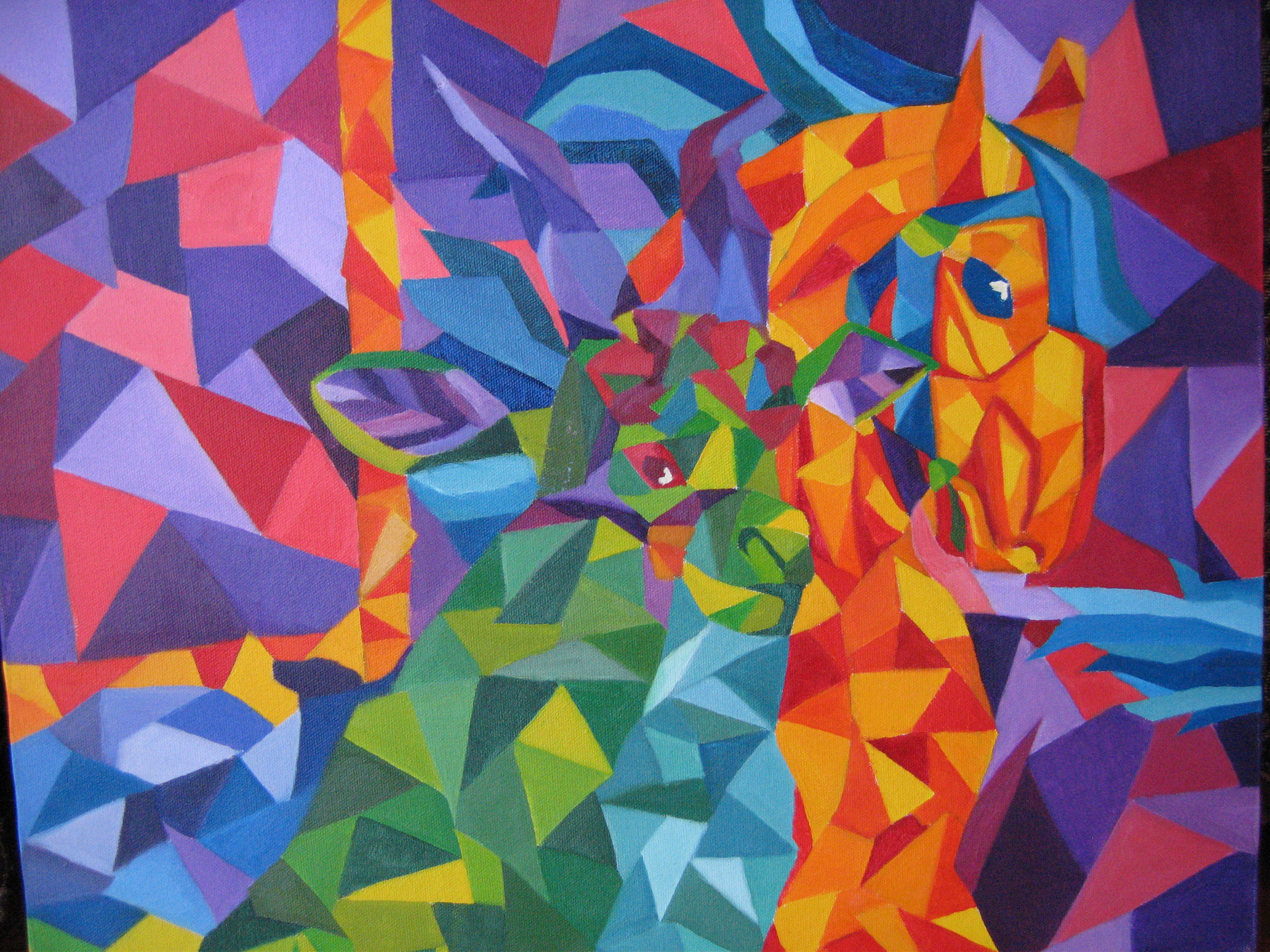
The Different Art Movements  Impressionism The impressionist art movement originated in France in the last quarter of the 19th century as a reaction against traditional art and its strict rules. A group of painters who became known as the Impressionists decided to gain independence from the standards prescribed by the French Academy of Fine Arts and France's annual official art exhibition called The Salon. Impressionism covers approximately two decades, from the late 1860s through the 1880s. The term impressionist was first used by French art critic Louis Leroy in 1874 based on Monet's painting Impression, Sunrise. Leroy found the term fitting to describe the loose, undefined and "unfinished" style that Monet and several other artists applied to their paintings. http://www.theartstory.org/movement-impressionism.htm?temp-new-window-replacement=true Expressionism Expressionism developed during the late 19th and early 20th centuries. Expressionis was opposed to academic standards that had prevailed in Europe and emphasized artist's subjective emotion, which overrides fidelity to the actual appearance of things. The subjects of expressionist works were frequently distorted, or otherwise altered. Landmarks of this movement were violent colors and exaggerated lines that helped contain intense emotional expression. Application of formal elements is vivid, jarring, violent, or dynamic. Expressionist were trying to pinpoint the expression of inner experience rather than solely realistic portrayal, seeking to depict not objective reality but the subjective emotions and responses that objects and events arouse in them. The expressionistic tradition was significantly, rose to the emergence with a series of paintings of Dutch painter Vincent van Gogh from the last year and a half of his life. There was recorded his heightened emotional state. One of the earliest and most famous examples of Expressionism is Gogh's "The Starry Night." Whatever was cause, it cannot be denied that a great many artists of this period assumed that the chief function of art was to express their intense feelings to the world. The Belgian painter and printmaker James Ensor was such an artist - with his sense of isolation. The Norwegian painter and printmaker Edvard Munch dealt - with different fears. The Vienesse painters Oskar Kokoschka and Egon Schiele first started with their expressionistic styles within Klimt's circle of the Vienna Secession. Vienesse Expressionism later gained significance between years 1905 and 1918 during a politically and culturally turbulent era of revelation of the profoundly problematic conditions of the turn-of-the-century Europe. Cubism Cubism is an art style spearheaded simultaneously by Pablo Picasso and Georges Braque.When they compared paintings in 1908, they realised that they had developed a new art style that was later dubbed by Guillaume Apollinaire to be ’cubism’. The two paintings above show how close the artwork of the two had become even though there was no intentional attempt to collaborate.Cubism broke from centuries of tradition by rejecting the idea that art should depict a single viewpoint. Instead they used an analytical system in which three-dimensional subjects were fragmented and redefined from several different points of view simultaneously.The hallmarks of cubism are the ’breaking down’ of form and space into geometrical shapes.In contrast to traditional painting styles where the perspective of a subject is fixed in one time and space, cubist work can portray the subject from multiple perspectives and multiple lapses of time.Cubism is sometimes regarded as having two phases – the Analytic phase (1907-12), and the Synthetic phase (1913 through the 1920s).The initial phase attempted to show objects as the mind, not the eye, perceives them.The Synthetic phase featured works that were composed of fewer and simpler forms, in brighter colours. Other major exponents of Cubism included Robert Delaunay, Francis Picabia, Jean Metzinger, Marcel Duchamp and Fernand Leger, Piet Mondrian and Sir Jacob Epstein. Surrealism Surrealists feasted on the unconscious. They believed that Freud's theories on dreams, ego, superego and the id opened doors to the authentic self and a truer reality (the "surreal"). Like the Dadaists, they relished the possibilities of chance and spontaneity.Their leader, the "Pope of Surrealism," was French writer André Breton (1896-1966), who joined fellow writers Philippe Soupault, Louis Aragon, Paul Éluard, and Robert Denos (among many others) in their appreciation of nineteenth-century "bad boys" Arthur Rimbaud (1854-1891) and Isidore Ducasse (whose pseudonym was Comte de Lautrémont, 1846-1870). One quote from Lautrémont's prose-poemLes Chants de Maldororexpresses the Surrealist spirit concisely: "the chance meeting on a dissecting-table of a sewing-machine and an umbrella!"Man Ray's The Enigma of Isidore Ducasse (1920) refers to this quotation.This approach to art was radical! Art schools and studios from time immemorial stressed the methodical application of one's skill. To let go of deliberate action - however, quickly or slowly executed it might be - seemed antithetical to the whole concept of art itself.For the Surrealists, the idea of skill from training was understood. Their philosophy was to let go of the constraints of learned skills and tradition methods of making art. They sought out children's art, naïf art (for example, Henri Rousseau), "primitive" art and "outsider" art (such as the art made by patients in mental institutions) to stoke the fires of their almost incoherent inventions.
|
||||||||